Great. We’re also working on our own article internally:
Packet Capture on the Route10
Capturing packets on the Route10 is a powerful way to detect and diagnose issues on your network. At times, Alta Support may request that you obtain a packet capture from your Route10 in order to understand and troubleshoot issues.
First off, you will need to be familiar with using SSH on the Route10. For more information about that, please refer to https://help.alta.inc/hc/en-us/articles/26753020799131-How-To-Use-SSH-Keys-For-Management
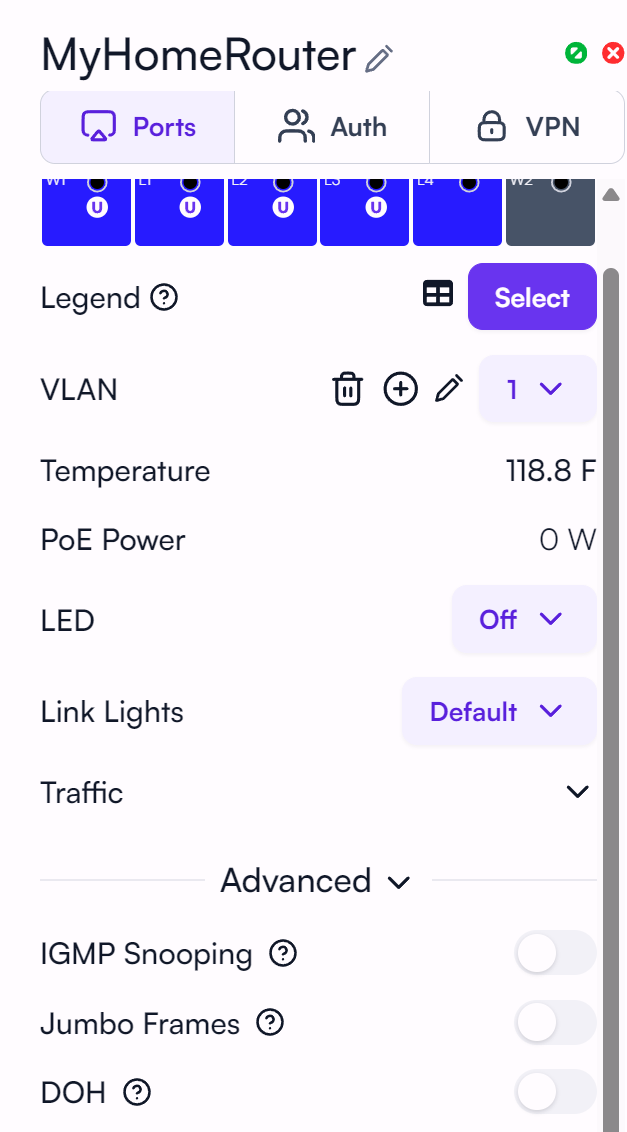
Secondly, it is important to disable hardware acceleration on the Route10, since only unaccelerated packets can be captured by the Linux system. To do this, click on the Device Icon in the Devices page, and under Advanced, set Acceleration to Disabled. After you have finished capturing packets, please be sure to set this back to the previous setting.
After you have ssh’ed to the Route10, you will need to decide which interface to capture packets on. The LAN interface(s) are in the format of “br-lan” and can have an optional VLAN tag on the end, i.e. “br-lan_2” for VLAN2. WAN interfaces are typically eth3 for WAN1, and eth4 for WAN2. Hover over the IP address of the Route10 in the Network Page to see a listing of all interfaces that are available on your Route10. You can also capture all packets on the Route10, all WANs, and all VLANs, by omitting an interface (remove the “-i br-lan” completely).
After you have determined the interface, you are ready to capture:
tcpdump -i br-lan -n -v -s 0 -w /tmp/cap.pcap
Hit CTRL-C after you have reproduced the issue you are experiencing. tcpdump should indicate the number of packets that have been captured as they are in progress. You can then use scp to copy the file off of the Route10, from a separate system:
scp root@192.168.1.1:/tmp/cap.pcap /tmp
(On Windows, it is easiest to use a GUI utility such as WinSCP)
If you expect your capture to exceed the amount of available RAM in the Route10, i.e. 1GB+, then it is recommended to perform a real-time capture, as outlined below.
Real-time capture
You can also tunnel packets to the Wireshark in real-time, or to avoid the storage constraints of the Route10. For a full guide on how to set up Wireshark for this, please refer to the article:
https://help.alta.inc/hc/en-us/articles/46512851684763-Using-your-Alta-Labs-Access-Point-as-a-WiFi-Sniffer
As an example, if you are tunneling the packets to port 3333 on your Wireshark system, it is important to filter out those packets with the “not port 3333” filter:
tcpdump -i br-lan -n -v -s 0 -w /tmp/cap.pcap not port 3333