Well after the recent debacle i am wondering what do I do. For me I demand demand robustness of software release processes and overall quality. There have been , to my thoughts, too may immediate updates after a release to fix a niggle or non conformance to various products over the last year or so. I am a domestic user and I am thankfully not a Production user. I have been through this sort of instability many years ago when the likes of the well known router companies had similar issues. we are really talking last century. How may of you were on call for Y2k ? Yes I was on call in the office and yes I am now retired. I want an easy life where my domestic network just ticks along with minimum overhead . Yes i am getting lazy but my expectation are not unreal. I was an early investor of Alta Labs equipment as I saw them as thought leaders. Now I an not so sure and recent experiences mean “ Do i Stay or Do i go. I m not sure as i am working through various WiFi issues now and now thinking I have to factory reset everything and start again. The lack of back up to the cloud based on dates and times to allow me to gracefully revert to a previous state is unacceptable. No I don’t want to run a syslog for my very simple network. Alta you need to choose are your target audience , enterprise or domestic. Certainly you are a disruption to my network from times to times. I want a quiet life that’s predictable and quality bound for the network that runs my IOT house.
i have used networking equipment before and never encountered any outages during “releases”, my thoughts are to ebay Alta kit and go back to a robust platform that is feature rich and robust?
These are my own thoughts and observation no criticism is implied of given,
I am using from time to time Alta Labs equipment. I set it up, test, test, test. Then, I go with another company for a while. Then I try Alta again.
There are some nice features and a nice UI to work with, but… I also do not update right away. It’s like back in the Microsoft days, test, test, test. Then, maybe update.
Yet, I still have high hopes for Alta Labs. Will they overcome? There are always growing pains with any company, but why release until it is at least stable. Base features first, then add value. But, this day and age not many companies will do that. However, I do see potential in Alta Labs and hope that they succeed.
One thing I would like to see it the dependency dropped for connecting to Alta Labs servers. A complete standalone setup that supports itself without connecting to another service on the Internet.
My biggest regret isn’t that I have almost $900 of alta gear sitting in its boxes in my closet, its that when my parents were looking to upgrade their network I recommended Alta gear which I’m on the hook for supporting.
There’s no denying that the hardware is great, but the software/firmware execution has been questionable for quite some time. The QA standards would require moving the goalposts to vet potential issues—which, as anyone knows, requires time and resources. To your point: who is Alta targeting?
I strongly believe this ecosystem was originally created to simplify and support their four other segments, which seem to be centered around audio/video for residential and commercial establishments. These segments are part of their parent brand, SVT (Soundvision Technologies). The individual segment lineups look quite impressive, but again, I don’t believe the intent for Alta was to challenge the status quo against mainstream competition with complex routing and switching options (at least to start).
These are growing pains; while some may have the patience to cooperate, others don’t. If my network is down, it’s a problem. I’ve decommissioned the Route10 and maintain just their switches and APs, which have been relatively stable from a hardware perspective—though every couple of updates knocks one of my switches offline. I’m working closely with Alta to help identify the update issues on my end—not just to ensure the stability of my network, but to help them better identify the root cause.
On the flip side, I’d suggest taking advantage of their support while it lasts. History has shown us that when small segments morph into larger operations, they tend to dial back that level of support.
I’ve been wondering the same.. UBNT really are releasing some nice gear that - I like Alta better, but the 5G gateway’s are sooo attractive. Software seems more customer stability ready too.
I like you have spent my career working in IT. I like Alta a lot and choose them over Unifi. This has a lot to do with liking the underdog in most cases and I saw Alta as a disrupter. Yes I had a beta max, and went with HD-DVD over Blueray. LOL
Being in IT for as long as I have. I have a high tolerance for computer pain and fixing my home computer is always low pri, because I spend all day fixing broken IT things. The home network is a different story. This is were the wife and kids come in. When they can’t make a phone call or can’t get on the internet for school work, or to watch the news. My “Non-Production” home network becomes the “Production” network and it needs to be fixed quickly. Its that whole happy wife, happy life thing and not having to listen to kids complain.
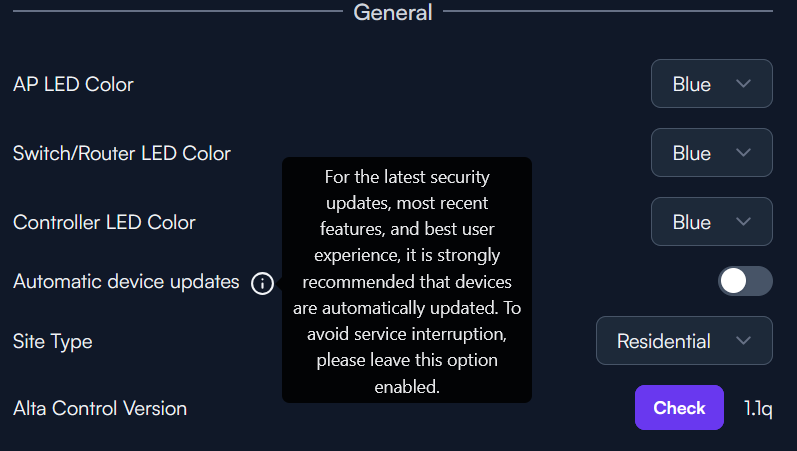
Because of all this I’ve set "Automatic Device Updates” to off, backup my local controller regularly and always check the readme and wait a few days to see what issues have been reported before updating. I know it defeats the purpose of the message in the screenshot, but after you have rebuilt your network config several times because you were burned hard on updates. This is what you do when you have not had the best experience and the trust is broken.
This concept works for managing and controlling upgrades per individual device with the exception of their local Alta Controller. The Control firmware will update whether you have updates on or not.
You are not alone. Many of us have run out of patience and grown tired of the number of bugs and products not meeting the marketing hype. Someone else mentioned this already, but I think they will settle into a network provider for installers using the SVT line of products. Anything more complex they are not well positioned to deliver or compete.
I like being able to tinker, and Alta gives me some of that. I do face the wrath of my wife and extended family (I’ve rolled out sites to my Elderly Parents and a brother) when things go wrong.
Would it make sense to create different channels? Say a “bleeding edge” channel, then a “recommended firmware” channel? Many years ago I built and maintained a pretty large Cisco network. Cisco Support always had us sit on a recommended firmware, to make sure we were always working
I’d also like to put out there, that part of the reason I like is that the Alta Engineers and CTO visit. I’ve found that they aren’t unreasonable to deal with either.
I have no issue with that and I understand your opinion. For me something like Microsoft Patch Tuesday would go along way to assert quality within the release cycle. Also comprehensive release notes prior to deployment gives customers an understanding of what the upgrade concerns. We as users can decide to early adopt the upgrade or take a more relaxed adoption. I also believe that a published release schedule is of immense interest. I have noted on monthly videos updates on YT commitment is vague along with timescales. I’m not sure why this information is uncertain just let customers know what the release cycle looks like. We are drip fed at best with little commitment. To be honest Alta are always in catch mode up so no real industry surprises.I am trying not to be too negative undoubtedly improvement can be easily implemented. However quality always costs.
Yes, I agree with you, they have settled into the market as a subsidiary of SVT. Somehow, I get the sense that Alta will grow as far as SVT will let them, which is the residential and SMB markets, and I am not seeing them in the prosumer and enterprise space at this time.
This is why I haven’t deployed any of their gear; it’s just a test rig for me to play with. The ALLs on YT are mostly banter, questions, and responding to customer queries. and sometimes featuring partners that use Alta gear.
I appreciated it when they used to put out how-to videos I could learn from, but these days, they are scarce. Additionally, I liked the case study videos highlighting customer installs, even though they are scarce. This scarcity tells a story.
In talking to Tom Lawrence, he made the point: What compelling reason is there to move away from the competition that is releasing features my customers actually want and need?
I disagree that residential and SMB markets are a valid target for alta labs. Volume is low and risk is too high to put their devices in these environments. I suspect they are really focused on the higher volume venues, multi dwelling units where switching is the primary volume driver, with very basic wireless needs. This drives volume in sales and has very low technical requirements. SMBs and residential can get complex quickly, not an area where I would recommend or ever use their products. As you quoted Tom Lawrence, there are some strong vendors out there that are releasing features and hardware that covers the SMB, residential, prosumer and enterprise environments very well, why would you try to put a square peg in a round hole and use something like alta labs?
Thinking about it strategically, the install videos on their YT chennel showcases, as you said, multi-dwelling units and commercial spaces. That’s probably the markets they can compete in comfortably.
I was forced to revert to the UI for a project earlier this year because customers kept asking for features that Alta does not have. Owing to my negative experience on here. I will stick with what works for my clients for the foreseeable future. Whenever I see new firmware, it gets the side eye.
The excuse that they (Alta) are growing is old and played out, as I am seeing a new full-stack company that’s making waves among YouTube influencers now, but they are not mature yet, and I will not consider them, as they are subscription-based and run on the old enterprise model
I actually do agree with your volume assessment where switched play a bigger role but the only thing is let people like to also utilize what they are going to use at work(to an extent they can at least). So they can become familiar with everything better and react better because you know where things are and stuff. I wanted to go alta to learn networking better but honestly it kind of feels like I spend more time sorting issues. It is a double edged sword as I feel they could be much better if they improved the UI and added some needed features. They have been pretty stable for me except for the whole if you cold boot then my sfp won’t sync properly with my isp.
I will say they do participate in the forums and try to help you and their support is much better then any other network support I’ve ever dealt with. Like we have VMware and Citrix at work that I’m in charge of and we pay… a lot.. for that support. I know alta is small so probably answers why their support is better but still. I was emailing with them multiple times a day for questions that weren’t even about my ticket at that point and they were answering.
Anyways if they could improve the UI more, get more stability especially around updates(I personally have never been affected by those), and implement more features it would go a long way.
I currently have a route 10, a 48 port switch, and a 12 port 10gb along with a ap6u. I also feel the switches are well made. The route 10 probably should of had 2x the ram for future growth as I figure eventually they’ll need to replace it to keep adding features. Biggest feature I want right now is just a basic GUI to diagnose issues. After you set it up in a controller you make a local user/pw that doesn’t give admin rights but will display basic information about the connection.
Is everything connected?
Does it have an IP/DNS?
What connection and profile on that connection is it currently using?
Just basic information that gives even a basic end user that is slightly tech savvy the ability to see what is going on. Since if you install a route10 in a remote office. Having the ability to walk one person through to see if it’s isp or router would be nice.